Autism
- mrsaepts
- Feb 17, 2024
- 3 min read
BY Phurinart Suandork, Hargun Jumpy, Aiyada Aiumwantanaonchai
EDITED BY Shinnisha Chulapongwanich
What is Autism?
Autism spectrum disorder (ASD) is a developmental disorder caused by differences in the brain. People with autism have problems with communication, interaction, and restricted or repetitive behaviors. They also have a unique way of thinking, learning, moving, or paying attention which can make life challenging.
Symptoms:
Avoids or does not keep eye contact
Does not respond to name by 9 months of age
Does not sing, dance, or act by 5 years of age
Cannot notice emotions
Does not share interests with other children by 15 months of age
Repeats words or phrases (echolalia)
Gets upset with minor changes
Must follow certain routines
Has unusual reactions to the way things sound, smell, look, or feel
Delayed language, movement, and cognitive skills
Epilepsy
Unusual eating or sleeping habits
Mechanism of ASD
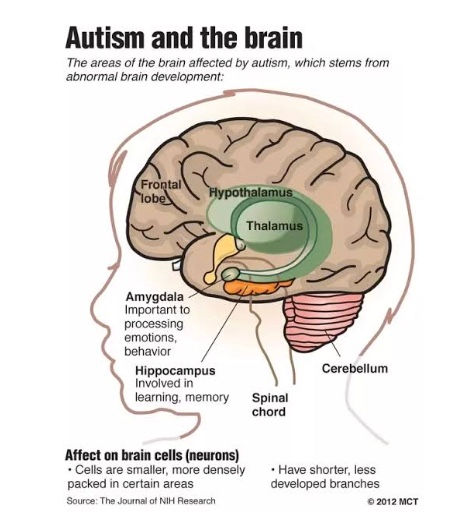
Mechanisms underlying autism have been extensively studied using different approaches. Some hypotheses include defects in synapse structures and function, disrupted neural circuit function, neuroinflammation and altered brain structure. This leads to differences in how information is processed, which can affect behavior, and communication.
Historically, the amygdala, a brain region associated with emotions and social behavior, has been implicated to play a role in Autism. Regions connected to the amygdala tend to be larger in children diagnosed with autism. Researches suggest that alterations in the structure and function may contribute to social and emotional challenges as observed in autistic individuals.
Risk Factors
There are currently not that much sufficient specific causes of ASD, as there are various factors that may cause the child to be more likely to develop ASD, in which these factors can be categorized into environmental, biological, and genetic factors, may include the following:
Have a sibling with ASD
Born to older parents
Undergo certain complications at birth
Have certain genetic or chromosomal conditions, such as Down, fragile X, Rett syndromes, and tuberous sclerosis
Furthermore, there are advancements in the discovery of a deeper understanding of various environmental risks, in which involve events that are more prominent before and during birth, such as:
Conception occurring at an older age of parents
Exposure to air pollution or specific pesticides during pregnancy
Maternal conditions like obesity, diabetes, or immune system disorders
Premature birth or extremely low birth weight
Complications during birth resulting in periods of oxygen deprivation to the infant's brain
Treatment
There are various approaches to reduce symptoms and help those with ASD perform better. Each method of therapy and interventions vary in efficiency in each person, but most do well-structured and specialized programs that aid in making daily activities easier to accomplish. Research emphasizes early diagnosis and treatment of Autism, particularly during preschool or earlier, as they are more likely to yield major positive effects on performance and learning future skills. It is highly important to prioritize a person’s specific needs rather than the diagnostic labels when it comes to which types of treatment to pursue.
Types of treatment for ASD may include:
Behavioral management therapy
Cognitive behavior therapy
Early intervention
Educational and school-based therapies
Joint attention therapy
Medication treatment
Nutritional therapy
Occupational therapy
Parent-mediated therapy
Physical therapy
Social skills training
Speech-language therapy
Works cited
“Autism.” National Institute of Environmental Health Sciences, www.niehs.nih.gov/health/topics/conditions/autism#:~:text=Although%20scientists%20are%20still%20trying,fragile%20X%2C%20and%20Rett%20syndromes.
“Autism Spectrum Disorder.” National Institute of Mental Health (NIMH), www.nimh.nih.gov/health/topics/autism-spectrum-disorders-asd#:~:text=Autism%20spectrum%20disorder%20(ASD)%20is,first%202%20years%20of%20life.
Autism Spectrum Disorder - Diagnosis and Treatment - Mayo Clinic. 6 Jan. 2018, www.mayoclinic.org/diseases-conditions/autism-spectrum-disorder/diagnosis-treatment/drc-20352934.
“Autism Spectrum Disorder - Symptoms and Causes - Mayo Clinic.” Mayo Clinic, 6 Jan. 2018, www.mayoclinic.org/diseases-conditions/autism-spectrum-disorder/symptoms-causes/syc-20352928.
“Basics About Autism Spectrum Disorder (ASD) | NCBDDD | CDC.” Centers for Disease Control and Prevention, 9 Dec. 2022, www.cdc.gov/ncbddd/autism/facts.html.
“---.” Centers for Disease Control and Prevention, 9 Dec. 2022, www.cdc.gov/ncbddd/autism/facts.html.
Ccp-C, Krista Elkins Ba, Rn, Crfn, Nrp,. “Autism Risk Factors.” Healthline, 20 Jan. 2023, www.healthline.com/health/autism-risk-factors.
“Signs and Symptoms | Autism Spectrum Disorder (ASD) | NCBDDD | CDC.” Centers for Disease Control and Prevention, 11 Jan. 2023, www.cdc.gov/ncbddd/autism/signs.html.
“What Are the Treatments for Autism?” https://www.nichd.nih.gov/, 19 Apr. 2021, www.nichd.nih.gov/health/topics/autism/conditioninfo/treatments.
“What Is Autism? | Autism Speaks.” Autism Speaks, www.autismspeaks.org/what-autism.
Comments