Down Syndrome
- mrsaepts
- May 30, 2023
- 3 min read
BY Apichat Chaisarn
EDITED BY Pakpol Kunopasvorakul
Key Points
Down syndrome is caused by irregularity of chromosome 21, resulting in mental and physical challenges.
Down syndrome occurs in approximately 1 in 700 live births.
There are three types of Down syndrome: Trisomy 21, Mosaic Down syndrome and Translocation Down syndrome.
The causes of Down syndrome are not fully understood, but significant risk factors include mother’s age and parents’ genetic translocation.
Individuals with Down syndrome often exhibit distinct features such as a flattened face, small head, short neck, protruding tongue, upward slanting eyelids, cognitive impairment, delayed language development, and other characteristics.
There is no treatment for Down syndrome, but early intervention can positively influence the affected person.
What is Down Syndrome?
Down syndrome is a congenital disorder caused by an extra copy or part of chromosome 21. The extra genetic material changes how the body and brain develop, resulting in challenges affecting their mental and physical abilities. Down syndrome occurs in approximately 1 in 700 live births. Down syndrome was named after John Langdon Down who first described the physical features of Down syndrome in 1866. It is also known as Down’s syndrome or trisomy 21 (Centers for Disease Control and Prevention [CDC], 2022; CDC, 2023; Mayo Foundation for Medical Education and Research, 2018).
Causes
Down syndrome is caused by an extra chromosome, but there is no answer to why it occurs or how many factors play a role. According to Centers for Disease Control and Prevention [CDC] (2023), there are three types of Down syndrome:
Trisomy 21: Trisomy 21 accounts for 95% of Down syndrome cases. The person has three copies of chromosome 21 in all cells. This is caused by abnormal cell division during sperm/egg cell development.
Mosaic Down syndrome: Mosaic Down syndrome is a rare form of Down syndrome, characterized by the person having only some cells with an extra copy of chromosome 21. This is caused by abnormal cell division after fertilization.
Translocation Down syndrome: Translocation Down syndrome is characterized by a portion of chromosome 21 becoming translocated (attached) to another chromosome, before or at conception.
Risk Factors
While the causes and risk factors are not fully understood, these are commonly recognized as significant risk factors:
Mother’s Age: Women who are 35 years or older have a higher likelihood of giving birth to a child with Down syndrome as shown in the figure below (CDC, 2022; CDC, 2023).
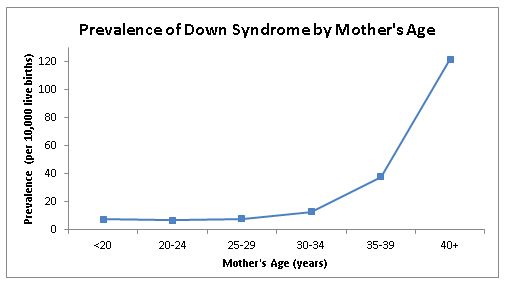
Figure 1: Prevalence of Down Syndrome by Mother’s Age
Note. From “Data and statistics on Down Syndrome,” by Centers for Disease Control and Prevention, 2022, Birth Defects. (https://www.cdc.gov/ncbddd/birthdefects/downsyndrome/data.html)
Parents’ Genetic Translocation: Parents can pass the genetic translocation for Down syndrome to their children (Mayo Foundation for Medical Education and Research, 2018).
Symptoms
Intellectual and developmental challenges of an affected person can vary from mild to severe. People with Down syndrome often exhibit unique distinct features. According to Mayo Foundation for Medical Education and Research (2018), some of the commonly observed features in individuals with Down syndrome include:
Flattened face
Small head
Short neck
Protruding tongue
Upward slanting eyelids (palpebral fissures)
Unusually shaped or small ears
Poor muscle tone
Broad, short hands with a single crease in the palm
Relatively short fingers and small feet
Excessive flexibility
Tiny white spots on the coloured part (iris) of the eye (called Brushfield's spots)
Short height
Mild to moderate cognitive impairment
Delayed language development
Short and long-term memory is affected
Treatment
Down syndrome is a lifelong condition that can be positively influenced by early intervention services, which aim to enhance the physical and intellectual abilities of affected people, maximizing their potential. Early intervention programs will provide crucial support through speech, occupational, and physical therapy. Some children with Down syndrome may require additional assistance or attention in school, but inclusive education in regular classes is common. (CDC, 2023)
Possible Health Complications
Some people with Down syndrome might have other birth defects or medical problems. According to CDC (2022; 2023), common health complications (that are affecting more than half of people with Down syndrome) include:
Hearing loss
Obstructive sleep apnea
Ear infections
Eye diseases
Heart defects
References
Centers for Disease Control and Prevention. (2022, December 16). Data and statistics on Down Syndrome. Birth Defects. From https://www.cdc.gov/ncbddd/birthdefects/downsyndrome/data.html
Centers for Disease Control and Prevention. (2023, May 9). Down syndrome. Birth Defects. From https://www.cdc.gov/ncbddd/birthdefects/downsyndrome.html
Mayo Foundation for Medical Education and Research. (2018, March 8). Down syndrome. Diseases & Conditions. From https://www.mayoclinic.org/diseases-conditions/down-syndrome/symptoms-causes/syc-20355977
Comments