Rheumatoid Arthritis
- mrsaepts
- Dec 7, 2023
- 6 min read
BY Ornnicha Wongpraparut, Sanruethai Sangiamsak, Voraveerin Pattanasinwanich
EDITED BY Napai Patamajintatumrong
What is Rheumatoid Arthritis?
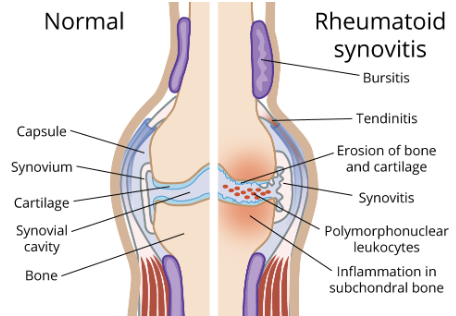
Rheumatoid arthritis (RA), an autoimmune disease, is a chronic inflammatory disease that occurs when the body’s immune system mistakes the healthy cells for invaders and releases chemicals to attack those cells. In RA, the synovium, connective soft tissue that lines the inner surface of joint capsules secreting thick synovial fluid lubricating the joint, is attacked. The inflamed synovium producing an excess of synovial fluid becomes thickened and swollen making the joint area red, stiff, and painful causing the difficulty in moving the joint. The specific cause of RA that triggers the immune system is still unknown. RA may occur at any age. It can affect three times as many women than men. As RA progresses, it causes painful swelling potentially resulting in bone erosion or joint deformity, which leads up to physical disabilities.

Stages of Rheumatoid Arthritis
Stage 1 : The joint tissues are mistakenly attacked by the body’s immune system. This is the stage where stiffness happens.
Stage 2 : Antibodies are developed; the synovial membrane in the joints is swollen and inflamed.
Stage 3 : The joints start to be contorted, for example, the fingers are crooked, which can lead to nerve pain.
Stage 4 : The joint is completely fused, and there is no joint remaining. (People with RA don’t reach this stage if they are treated.)
Risk factors
Researchers have explored various genetics and environmental factors to identify the elements that may increase the chances of rheumatoid arthritis (RA). Several risk factors identified for developing RA include:
Age: Individuals aged sixty and above face the highest risk of developing RA.
Sex: Recent studies indicate that women have more chances to develop RA compared to men.
Genetics/inherited traits: Those who are born with HLA (human leukocyte antigen) class ll genotypes are at a heightened risk of RA, especially when they are exposed to environmental factors like smoking.
Smoking: Smoking cigarettes not only increases the risk of developing RA but can also worsen the disease.
History of live births: Women who never gave birth may have an increased risk of RA.
Early Life Exposures: Exposure to certain factors in early life may elevate the risk of RA in adulthood. For instance, research suggests that children whose parents smoked have a double risk of developing RA.
Obesity: Being overweight or obese can increase the risk of developing RA.
Symptoms
One of the most obvious signs of RA is chronic and constant pain. This pain is often accompanied by swelling, stiffness, and muscle pain surrounding a joint. In the early stages, people with RA may feel the pain but no redness or severe swelling. If left untreated, RA will be worsened.
Common symptoms of RA include :
Joint pain, tenderness, swelling and stiffness that may last for six weeks or longer
Morning stiffness that lasts for 30 minutes or longer
More than one joint is affected
Small joints (wrists, hands and feet) are typically affected first
Same joints on both sides of the body are affected
Severe fatigue, mild fever, loss of appetite
Changes to the skin and nails color and appearance
Anemia as chronic inflammation lowers the production of red blood cells
RA symptoms may come and go. Having a lot of inflammation and other symptoms is called a flare. It may occur when symptoms suddenly worsen and can last for days or months.
Treatment
Nowadays, there exist some treatments for RA disease: medication, reduction of joint stress with physical and occupational therapy, and surgical interventions.
Pharmacological Strategies
These are some major types of drugs used to treat RA with different functions and conditions.
(NSAIDs) Non-steroidal Anti-inflammatory Agents- The drug decreases acute inflammation and pain, improves function, has short-onset action, and improves symptoms of active RA.
Corticosteroids - It affects anti-inflammatory and immunoregulatory activity; it is temporary/chronic adjunctive therapy.
(DMARDs) Disease Modifying Anti-rheumatic Drugs- Like NSAID, it suppresses symptoms of active RA. Moreover, it decreases the chance of pathophysiology and prevents radiographic progression. However, it takes several weeks to months to have clinical effects, and the treatment should be started right after the RA diagnosis is confirmed. Some of the DMARD drugs are Methotrexate, Sulfasalazine, Hydroxychloroquine (Plaquenil), and Leflunomide.
(TNF) Tumor Necrosis Factor Inhibitor- TNF is a pro-inflammatory cytokine made by macrophages and lymphocytes. On the contrary, it turns out to decrease joint destruction because of its effects on cells in joints as well as other organs and body systems.
T-cell Costimulatory Blocking Agent, Abatacept (Orencia®) - It involves the interaction between antigen-presenting cells, T lymphocytes, and the pathogenic cascade of events in RA in the early stage. It is made of fusion protein with extracellular domain CTLA4 and Fc section of a human immunoglobulin molecule.
B cell Depleting Agents, Rituximab (Rituxan®)- B cell, an inflammatory cell, plays many roles in an immune response. The diminishing amount of B cells also causes the decrease of RA signs and symptoms as well as slowing radiographic progression. Rituximab is constructed of the chimeric monoclonal antibody that bonds with the CD20 molecule on the B cell surface.
(IL-1Ra) Interleukin-1 Receptor Antagonist Therapy - Unlike TNF, IL-1Ra is an anti-inflammatory cytokine and also acts as the antagonist of the IL-1 receptor.
Treatment during pregnancy - Most drugs are considered unsafe to be used during pregnancy, specifically DMARDs. Therefore, it creates complications in the treatment.
Reduction of joint stress - It is the type of treatment that depends on management. These are some of the approaches, for example, yielding ideal body weight, avoiding vigorous activity, and practicing modest levels of activity. Most importantly, this type of treatment should be instructed and consulted with physical and occupational therapists.
Surgical approaches - Surgical operations can become risky and beneficial according to each case. The two examples of surgical approaches are Synovectomy and Arthroplasty. Synovectomy is a preventive operation that treats conditions affecting synovium (thin membrane in the synovial joint), such as synovitis. Arthroplasty is a reconstructive procedure that restores the function of a joint.
Preventions
According to medical researchers, there are 9 simple steps to reduce the risk for those at risk:
Stop smoking: Smoking can affect the immune system through heightened oxidative stress, inflammation, and the promotion of apoptosis (cell death) in the body. Quitting smoking as well as avoiding secondhand smoke is proven to be beneficial in preventing rheumatoid arthritis (RA).
Limit Alcohol: For individuals with RA, alcohol is a main concern as it could interact with medications you take for treatment of the condition. Certain medications used for RA, such as methotrexate, can damage the liver. Since alcohol consumption can also harm the liver, it may increase this risk.
Minimize Bone Loss: Rheumatoid arthritis (RA) is linked to the loss of bone density and the development of osteoporosis. Therefore, the pain and joint stiffness resulting from RA may lead to reduced physical activity, elevating the risk of osteoporosis. Additionally, the glucocorticoid medications used to treat RA can contribute to bone loss. Therefore, it is important for patients to prevent or slow down RA-associated bone loss by maintaining a diet rich in calcium or vitamin D, engaging in weight-bearing exercise, or taking guidance from their healthcare provider.
Improve Oral Health: Inflammation contributes to the development of RA. To minimize the risk of inflammation, maintain good oral hygiene by taking care of your teeth and gums and taking regular check-ups.
Increase Fish Intake: Fish is abundant in various nutrients, especially omega-3 fatty acids, and vitamins A and D. Studies indicate that eating fish multiple times a week may offer protective benefits against the development of RA.
Maintain a Healthy weight: Maintaining a healthy weight along with getting enough vitamins and minerals may reduce your risk of RA.
Stay Active: Regular exercise not only improves your overall health but can also help chronic disease.
Reduce Pollutant Exposure: The HLA gene, in particular, is associated with the development of RA, and research indicated that pollutants like dioxin and cigarette smoke are connected to the development of the disease in individuals with this gene.
Take early Action: If you suspect you have RA or are at risk of developing the condition, consult your healthcare provider. Early treatment with medications helps prevent severe joint and organ damage.
References:
“Rheumatoid Arthritis - Orthoinfo - AAOS.” OrthoInfo, orthoinfo.aaos.org/en/diseases--conditions/rheumatoid-arthritis/. Accessed 18 Nov. 2023.
Donvito, Tina. “The 4 Stages of Rheumatoid Arthritis Progression.” CreakyJoints, 2 June 2023, creakyjoints.org/about-arthritis/rheumatoid-arthritis/ra-overview/rheumatoid-arthritis-stages-progression.
“Rheumatoid Arthritis (RA).” Centers for Disease Control and Prevention, Centers for Disease Control and Prevention, 27 July 2020, www.cdc.gov/arthritis/basics/rheumatoid-arthritis.html#risk.
Rachael Zimlich, BSN. “Preventing Rheumatoid Arthritis.” Verywell Health, Verywell Health, 1 Sept. 2023, www.verywellhealth.com/preventing-rheumatoid-arthritis-5096031.
“Rheumatoid Arthritis: Causes, Symptoms, Treatments and More”, Arthritis Foundation, www.arthritis.org/diseases/rheumatoid-arthritis, Accessed 19 November 2023.
“Rheumatoid Arthritis Treatment Options | Johns Hopkins Arthritis Center.” Johns Hopkins Arthritis Center, 14 Apr. 2020, www.hopkinsarthritis.org/arthritis-info/rheumatoid-arthritis/ra-treatment.
“Arthroplasty.” John Hopkins Medicine, 2019, www.hopkinsmedicine.org/health/treatment-tests-and-therapies/arthroplasty.
Benjamin, Onecia, et al. “Disease Modifying Anti-Rheumatic Drugs (DMARD).” PubMed, StatPearls Publishing, 4 July 2022, www.ncbi.nlm.nih.gov/books/NBK507863/.
“Rheumasurgery: Improving Function and Relieving Pain.” News-Medical.net, 19 Apr. 2023, www.news-medical.net/health/Rheumasurgery-Improving-Function-and-Relieving-Pain.aspx#:~:text=Hand%20surgery%20for%20RA%20is. Accessed 6 Dec. 2023.
Sanmarti, R. “Radiological Progression in Early Rheumatoid Arthritis after DMARDS: A One-Year Follow-up Study in a Clinical Setting.” Rheumatology, vol. 42, no. 9, Mar. 2003, pp. 1044–49, https://doi.org/10.1093/rheumatology/keg284. Accessed 29 Jan. 2020.
“Synovectomy for Synovitis: Arthroscopic or Open Surgery.” Hospital for Special Surgery, www.hss.edu/conditions_synovectomy.asp.
Zhang, Fang, et al. “Interleukin-1 Receptor Antagonist: An Alternative Therapy for Cancer Treatment.” Life Sciences, Nov. 2023, https://doi.org/10.1016/j.lfs.2023.122276.
“What is Rheumatoid Arthritis?” pwcl, pcwfl.com/too-much-synovial-fluid-a-cause-for-rheumatoid-arthritis-pain-what-is-rheumatoid-arthritis/. Accessed 19 November 2023.
Comments